
Free
1 pageQuick Start
Guide
Guide
Quick Start Guide
One page with everything you need for your first game. Print a copy for each court.
Youth groups · youth camps · retreats
A fast 2-on-2 game that gets the whole group playing at once. All you need is four tables the same size and a tennis ball, and everything you need to start is free.
Why it works
Hantis was invented by students in a classroom, and it still works best with a crowd.
In Freestyle, players who get out go to the back of the line and everyone else rotates up, like four square. Nobody sits on a bench, and partners change almost every point.
Nobody has played it before. First-time visitors and kids who don't play sports start on the same level as your athletes, so the new kid fits right in.
Any type of table works, as long as all four are the same size (rule 1.0.1). No nets, no rackets, no paddles. You hit the ball with your hands, or any other part of your body.
Push four tables into a square and serve. Teardown is just as quick, so it fits the slot before or after your program.
Gym, fellowship hall, parking lot, park or beach (rule 1.1.0). It's a ready-made rainy-day game for camp.
Each player gets two hits, and the best way to score is to pass to your teammate. Players call their own games and settle disputes with a replay or rock, paper, scissors (rule 7.0.2).
Ideas
Start with Freestyle, where anyone can walk up and join the line. When your group is hooked, run a Competitive tournament.
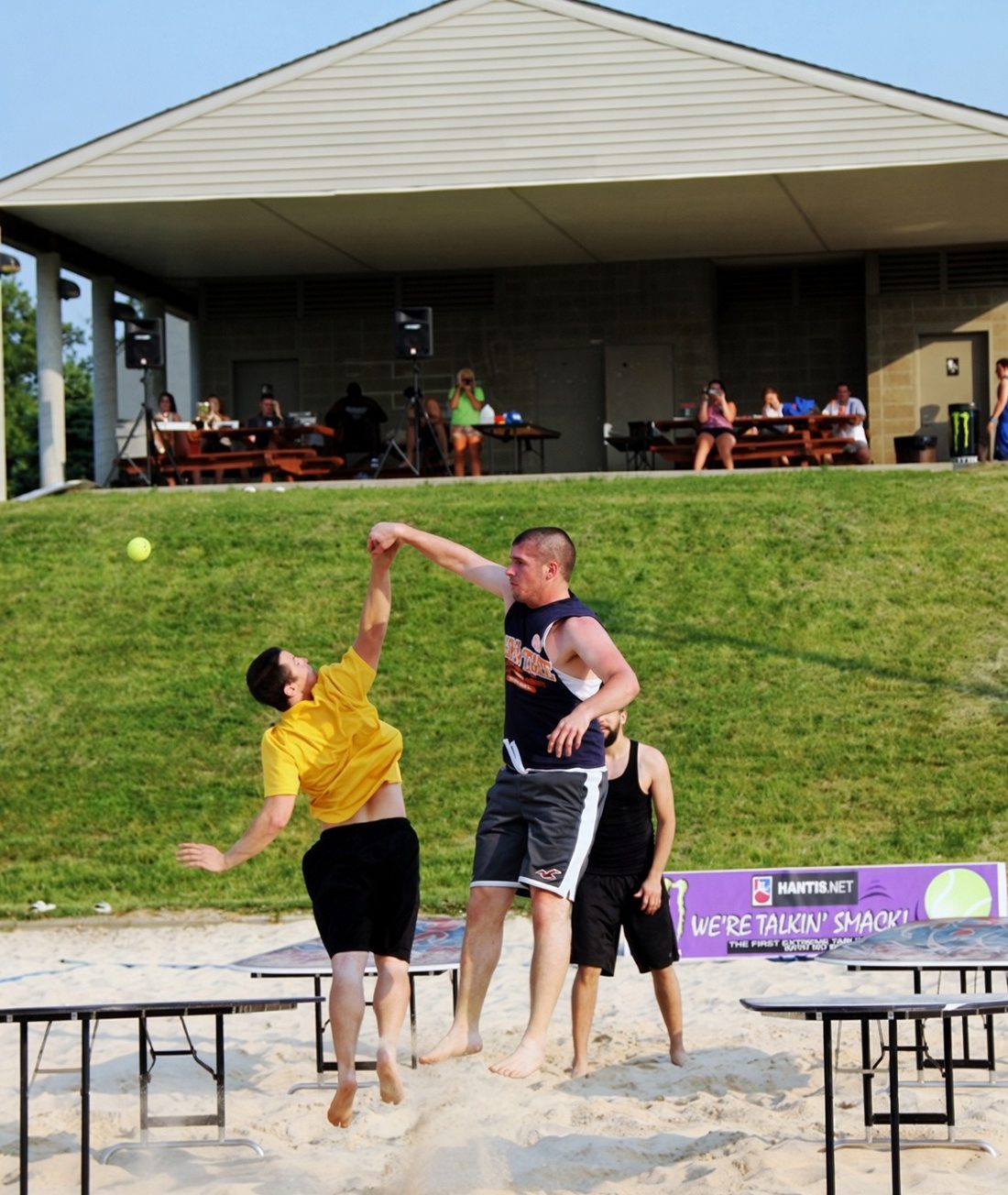
Watch
Your group will understand Hantis faster by watching one rally than by hearing the rules. Put the 60-second intro on the screen, then hand out a ball.
Your first session
Most groups are playing within five minutes. Here's the whole plan.
Play the 60-second intro for the whole group. It covers the serve, the two hits and the rotation.
Same size, in a 2×2 square. Start with the beginner gap of 3 ft (90 cm) between tables. Setup guide.
A new one from a pressurized can bounces best. Clear away bags and chairs; the walls can stay.
Strike the serve onto your own table, then theirs. Two hits each. One bounce on each of your team's tables.
Four players at the tables, everyone else in line by Table 1. Get out and go to the back. Bigger group? Add another court.
Once they're hooked, play Competitive with fixed teams of two. Print brackets and scoresheets from the free Organizer Kit.
Resources
Everything here is a free download except the optional build guide. You may print, copy and share the rulebook and the Quick Start at camps, clubs and community events (Terms).
One page with everything you need for your first game. Print a copy for each court.
Every rule for both modes, with diagrams. Handy for your leaders and counselors.
Want a dedicated set? Build four tables in the official shape from one sheet of plywood. A good project for a volunteer crew.
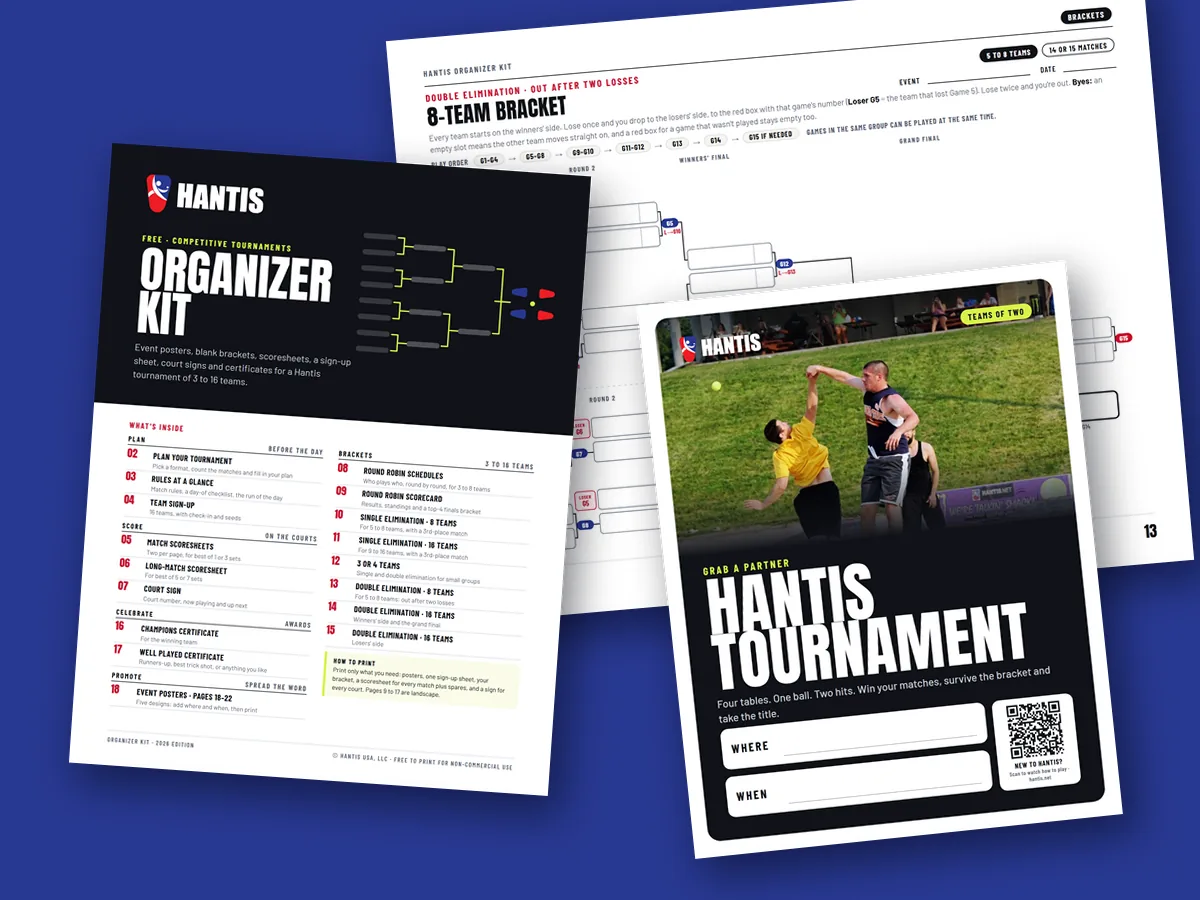
Free download
Running a cabin vs. cabin tournament or a youth group bracket? Everything to print for a Competitive tournament of 3 to 16 teams, plus posters to bring players in. Print only the pages you need.
Table gaps, court boundaries, and how to run several courts in one gym. Set up a court →
A short episode for every skill, from the first serve to trick shots, plus a rule clip for every way to get out. Watch →
Match formats, Competitive scoring, brackets and a day-of checklist for your tournament. Run an event →
Questions
Everyone plays. In Freestyle, players who get out go to the back of the line and everyone else rotates up, so there's no bench and partners change almost every point. It's new to everybody, so first-time visitors and kids who don't play sports start on the same level as your athletes. And it only needs four tables and a tennis ball.
Four tables of the same size and a tennis ball (rules 1.0.0 and 1.0.1). Folding tables, cafeteria tables and picnic tables all work. A new ball from a pressurized can bounces best; on less-bouncy plastic tables, try a high-bounce rubber ball.
Four play at a time on each court (one set of four tables), with everyone else in line. About 12 players per court keeps the line moving quickly. For a bigger group, set up more courts. See the setup guide.
Yes. A gym or a fellowship hall works well. Walls and ceilings are X-Factors, so the ball stays in play off them (rule 1.1.4). Move bags, chairs and loose balls out of the way, and keep the waiting line back from the tables.
No. Players call their own games. If there's a dispute and no referee, replay the point, play rock, paper, scissors, or check the video (rule 7.0.2).
Yes. The Official Rulebook and the Quick Start Guide are free. You may print, copy and share them for non-commercial use, such as in clubs, camps and community events, as long as you don't change them or remove the Hantis name and logo (Terms).
Yes. The free Organizer Kit (PDF, 22 pages) has round-robin schedules for 3 to 8 teams, single and double elimination brackets for 4, 8 and 16 teams, match scoresheets, a team sign-up sheet, court signs, five event posters and certificates.
No. The rules, the Quick Start Guide, the Organizer Kit, the setup guide and the videos are free. The only paid item you might want is the optional $29 Table Build Guide, if you'd like to build a dedicated set of tables in the official shape.
Four tables. One ball. Two hits.